In this section you can see the main communication parameters
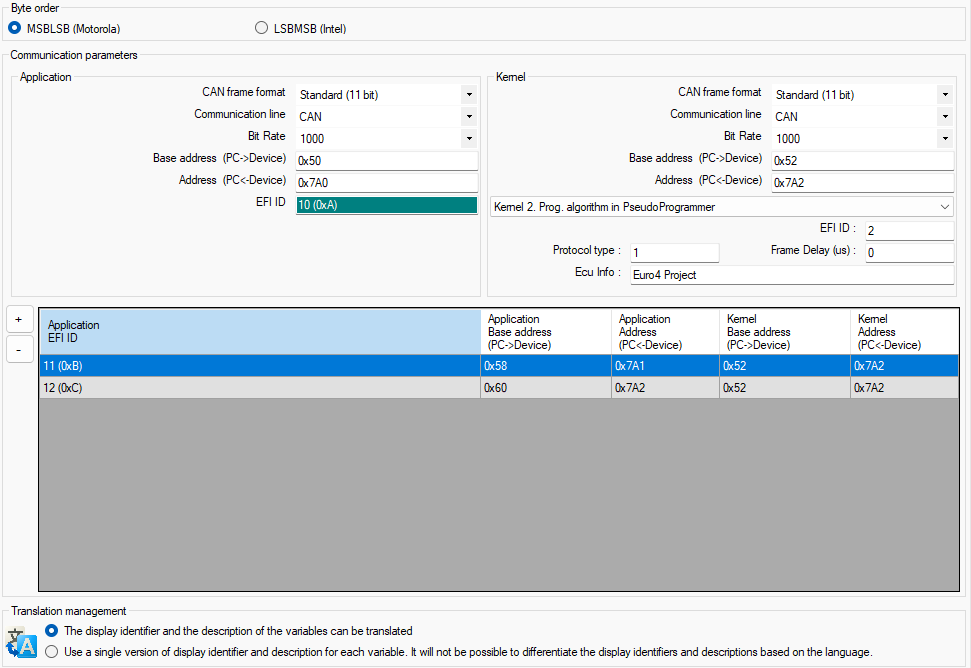
BYTE ORDER
There are two options that relate to the method of data representation in memory.
-
Motorola MSGLSB (in most EFI projects)
-
Intel LSBMSB
The option can only be changed if Expert mode is set
COMMUNICATION PARAMETERS
The communication parameters area is divided into 2 parts: application and kernel.
The application part contains the parameters for communicating with the application sw of the ECU. These parameters are used in monitoring the functioning of the unit and in the activities of calibration adjustment.
In this section you can manage
-
The CAN frame format (11 bit or 29 bit). Meaningful for CAN line only.
-
The type of communication line (CAN or K)
-
The bit rate (possible values 125,250,500,1000 for CAN line and 9600,19200,38400,57600 for K line)
-
The CAN ID for ECT requests to application sw of the ECU
-
The CAN ID for replies of application sw of the ECU to ECT.
In the case of the CAN line, is also shown the EFI ID that in fact is the requests ID / 8.
The EFI ID is used in some parts of ECT (log files, windows, information, etc.)
The kernel part contains the parameters for communicating with the ECU kernel sw. These parameters are used in programming the application sw and in some devices the calibrations.
In this section you can manage
-
The CAN frame format (11 bit or 29 bit). Meaningful for CAN line only.
-
The type of communication line (CAN or K)
-
The bit rate (possible values 125,250,500,1000 for CAN line and 9600,19200,38400,57600 for K line)
-
The CAN ID for ECT requests to kernel sw of the ECU
-
The CAN ID for replies of kernel sw of the ECU to ECT
-
The choice between legacy kernel and latest generation kernel
In the case in which the selected kernel is the latest generation kernel, there are also other parameters
-
EFI ID
-
Protocol type (usually 1)
-
Frame delay (usually 0)
-
ECU Info – different for each project and assigned by the EFI designers