• Home
  • Privacy policy
  • Italiano
  • English
  • Home
  • Privacy policy
  • Italiano
  • English
  • Software
    • ECT
      • ACKNOWLEDGEMENT
      • SYSTEM REQUIREMENTS
      • COMMUNICATION SCHEMES
      • DIRECTORY STRUCTURE
      • AVAILABLE TOOLS
      • INSTALLATION
      • GETTING STARTED
      • MAIN MENU
      • DEVICE EDITOR
        • ELF ORIENTED DEVICES AND NOT ELF ORIENTED DEVICES
        • STORAGE STRUCTURE OF THE DEVICE DATABASES
        • DEVICE LIST
          • CONTEXTUAL MENU IN THE DEVICE LIST
          • TOP BAR MENU
        • PAGE FOR EDITING THE VALUES IN THE DATABASE
          • TOP BAR MENU
          • MAIN - COMMUNICATION PARAMETERS AND OTHER SETTINGS
          • SCALINGS SECTION
          • INCREMENT SECTION
          • GROUPS SECTION
          • CHANNELS
          • CALIBRATION PARAMETERS
          • MEMORY MAP
        • COMMAND LINE USAGE
      • MEMORY INTERFACE
        • SEND (PC->ECU)
        • LEARN
        • RESET DIAGNOSTIC DATA
        • HDP/CRP MANAGER
        • MEMORYINTERFACE SETTINGS
      • DISPLAY
        • TYPES OF CONTAINERS
        • PROFILE STRUCTURE
        • CONTAINER MANAGEMENT
        • CONTROLS
        • MODIFICATION OF A CONTAINER
        • DATA RECORDING - F3 LOG
        • DISPLAY SETTINGS
      • CALIBRATION EDITOR
        • CALIBRATION TYPES
        • LOADING A CALIBRATION
        • WORKING WITH CALIBRATION EDITOR
        • CALIBRATION COMPARISON
        • PRINT THE VALUES OF THE CALIBRATION VARIABLES
        • SAVING CHANGES
        • DELETING A CALIBRATION FILE
        • CALIBRATION SETTINGS
      • ASAP3
      • CHARTING TOOL
        • LOADING A DATA FILE
        • MAIN MENU
        • CHANNEL LIST
        • CURSOR
        • SEGMENTS
        • DISPLAY LAYOUT
        • DISPLAY ORIENTATION
        • ZOOM
        • LINK ANALYSIS DISPLAY WITH ENGINE MAP
      • APPENDICES
        • STRING FORMAT
      • VERSION HISTORY

CONTAINER MANAGEMENT

73 views 0

By clicking the right mouse button on the ‘Data displays’ menu, you get the following submenu items
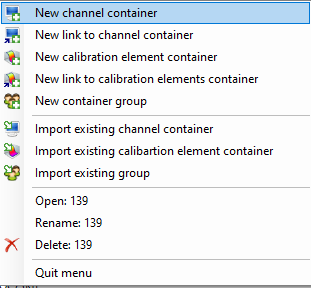


* New channel container
creates a new blank container in which you can insert controls. Controls allow you to monitor the channels of the ECU. The container is placed on the current level.

* New link to channel container
adds to the list of available containers a link to a channel container stored a folder other than the folder corresponding to the current level.

* New calibration variable container
creates a new blank container in which you can insert calibration variables. The container is placed on the current level.

* New link to calibration variable container

* New container group
creates a new empty group. In terms of file system, a group is a SUS folder that allows you to organize the containers to a level above the current one.

* Import existing channel container
adds a copy of an existing channel container folder to the folder corresponding to the current level

* Import existing calibration variable container
adds a copy of an existing calibration variable container folder to the folder corresponding to the current level

* Import existing group
adds a copy of an existing group (.SUS) folder to the folder corresponding to the current profile (.USR) folder)
By activating the menu on the name of an existing container, you also get other two menu items

* Rename
allows you to rename the window

* Delete
allows you to delete the window

Was this helpful?

Yes  No
Related Articles
  • VERSION HISTORY
  • STRING FORMAT
  • APPENDICES
  • ASAP3
  • PRINT THE VALUES OF THE CALIBRATION VARIABLES
  • LINK ANALYSIS DISPLAY WITH ENGINE MAP

Didn't find your answer? Contact Us

Previously
PROFILE STRUCTURE
Up Next
CONTROLS
Copyright 2026 EFI Technology S.r.l. (Company subject to the management and coordination activities of MTA S.p.A.) All Rights Reserved.
We use cookies to make sure you can have the best experience on our site. If you continue to use this site we will assume that you approve our use of cookies.